Back to Projects

Multi-Source Lead Routing for Home Services

A unified GoHighLevel pipeline pulling Facebook Lead Ads, Google LSAs, and web forms into one routing layer with sub-2-minute response.

2025 Lead Automation Engineer GoHighLevel
GoHighLevelFacebook Lead AdsGoogle LSAWebhooksA2P 10DLCTwilio
taimoorakhtar.com/projects/lead-routing-roofing
Multi-Source Lead Routing for Home Services

Introduction

A national roofing operator was running paid acquisition across three platforms — Facebook Lead Ads, Google Local Services Ads, and inbound web forms — with three completely separate inboxes feeding three sales reps. Speed-to-lead was averaging 47 minutes. Conversion was bleeding.

The Challenge

Each lead source had its own intake mechanism, formatting quirks, and tagging conventions. There was no single source of truth. Leads were duplicated, mis-attributed, and frequently lost in handoff. Worse, the SMS layer had zero A2P 10DLC compliance — outgoing texts were being filtered by carriers before reaching prospects.

The Solution

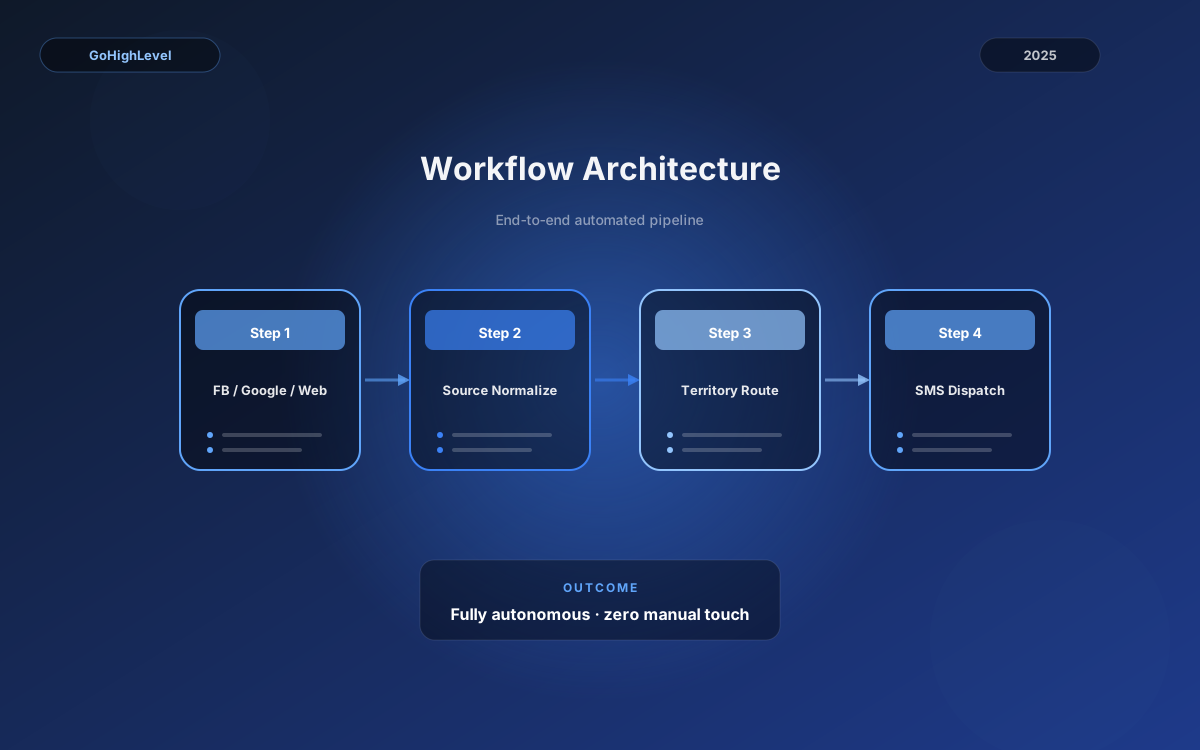
Built a unified ingestion layer in GoHighLevel that normalizes every lead source into a single canonical contact record, then routes by territory, source priority, and rep availability. SMS is dispatched through TCR-registered campaigns with verified opt-in language.

Technical Deep Dive

1
Webhook ingestion architecture. Facebook Lead Ads forward via native GHL integration; Google LSAs route through Twilio webhooks parsing the call notification payload; web forms post directly to GHL inbound webhooks. All three normalize to the same custom-field schema.
2
Territory-aware routing logic. Built a workflow that pulls zip code → assigns owner from a Google Sheet lookup table → applies stage tag → triggers initial SMS within 90 seconds, all before the lead notification reaches the rep.
3
Round-robin with capacity caps. Reps have daily lead caps in their user profile. Workflow checks current-day count via custom field, skips capped reps, falls back to overflow queue. No more lopsided distribution.
4
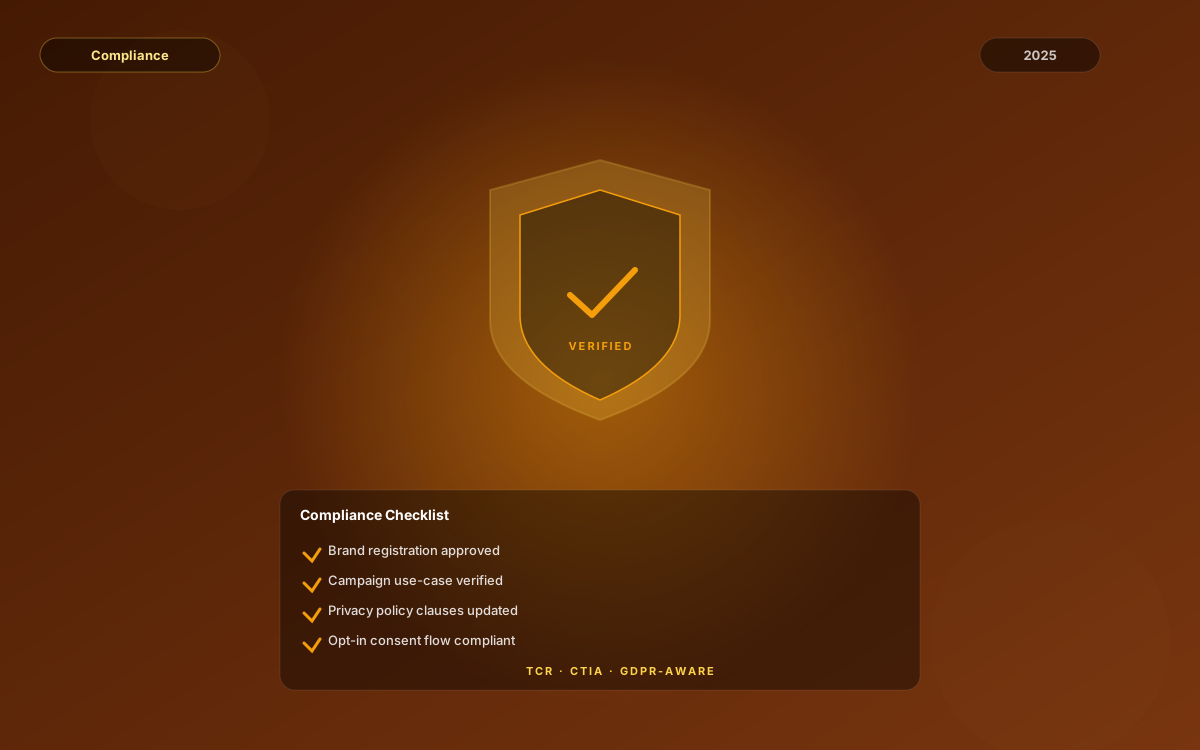
A2P 10DLC compliance layer. Brand and campaign registered with TCR. Privacy policy and terms updated with explicit mobile data sharing language. Opt-in flow uses double-confirmation with stored timestamp for audit trail.
5
Attribution tracking. Every lead inherits a UTM-equivalent custom field set at ingestion. Looker Studio pulls this for full source-to-revenue attribution — first time the operator could see actual ROAS by platform.
Key Features

Results & Impact

  • Speed-to-lead dropped from 47 minutes to 90 seconds average
  • Booking rate increased 31% in the first 60 days
  • Zero leads lost to duplication after migration
  • SMS deliverability hit 98%+ post-A2P registration

Lessons Learned

"Speed-to-lead beats lead quality at every threshold under 5 minutes — the routing system is the conversion lever."
"Don't trust native integrations to normalize fields — always normalize at ingestion in a controlled workflow."
"A2P 10DLC is a one-time setup tax that pays back forever in deliverability. Skip it and your SMS is shadow-filtered."

Related Work

Have a similar build in mind?

I'm available for engagement on GoHighLevel implementations, A2P 10DLC compliance, AI automation pipelines, and CRM migrations. Most projects start at $300–$1,200 depending on scope.